📋 Summary
During a critical spawn run (Day 8–9), a mushroom grow room failed to cool despite the AC running continuously for 32 hours. The Contol-X monitoring system logged every data point in real time. Analysis of sensor records revealed the AC was delivering only 1.2% of its rated cooling capacity — a clear sign of complete refrigerant loss. An AC technician was called immediately. The diagnosis was confirmed: R-404A refrigerant had fully leaked. After recharging, the room returned to normal operation. The batch was saved.
The Situation — Day 8-9 of a Spawn Run
Spawn Run Day 8–9 is one of the most critical and heat-intensive periods in button mushroom production. Mycelium is at peak metabolic activity — generating significant biological heat from within the compost. At this stage, the grow room AC must work against both the external summer heat and the internal biological heat load simultaneously.
On the night of May 9, 2026, something was wrong. The room temperature was not dropping — despite the AC running continuously and the operator aggressively lowering the setpoint from 22°C all the way down to 16°C over several hours. The room refused to cool.
What the Sensors Showed
The Contol-X system continuously logs all room parameters — room air temperature, compost core temperature, outside temperature, CO₂ levels, relay states, and setpoints — every few minutes. This is what the 31-hour record looked like:
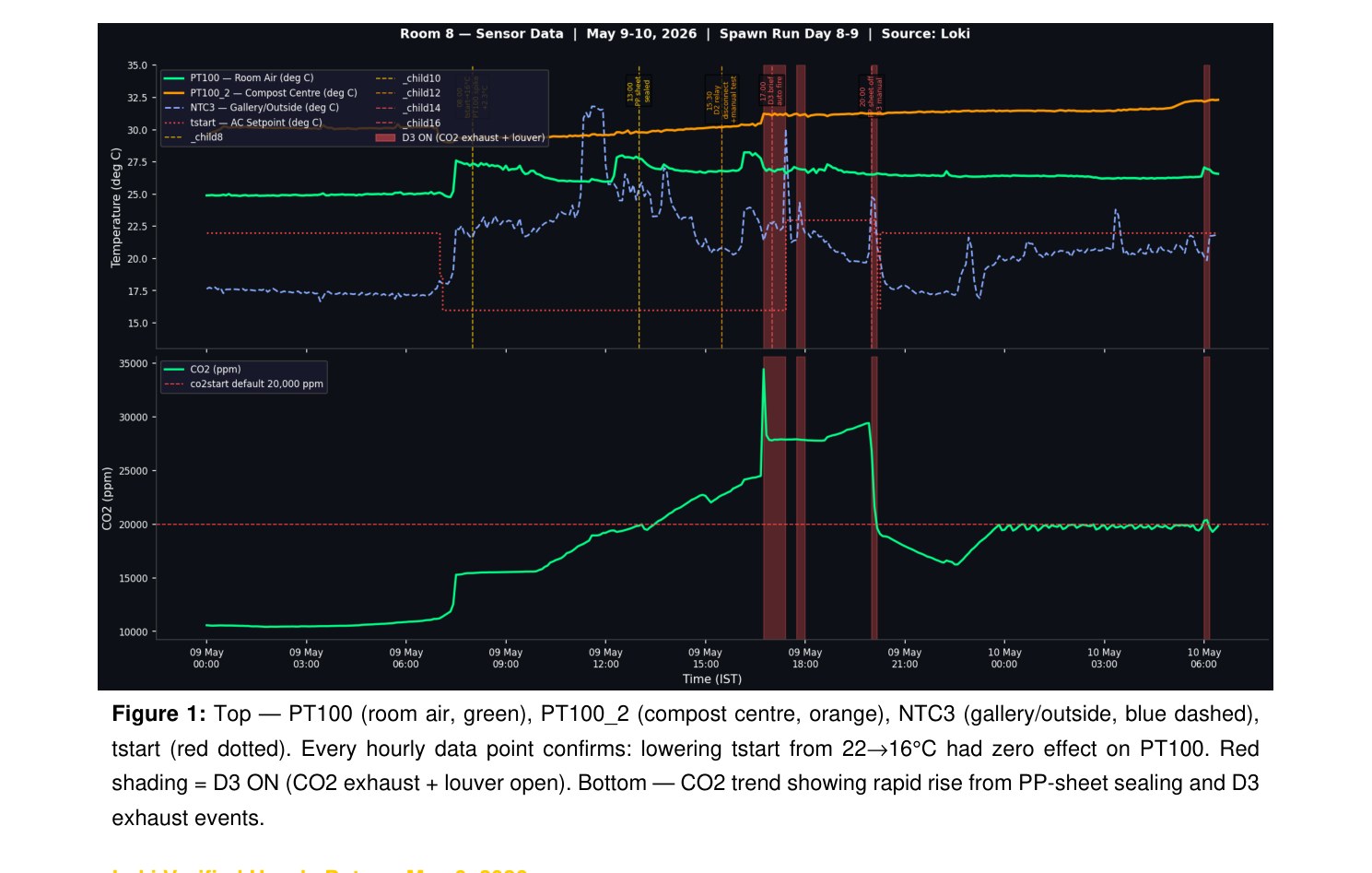
Figure 1 — 31-hour sensor record. Top: Room temperature (green) barely moved despite AC running and setpoint being lowered to 16°C (red dotted line). Compost centre (orange) steadily rising due to peak spawn metabolic activity. Bottom: CO₂ levels over the same period.
The Engineering Analysis — AC Producing 1.2% of Rated Output
The sensor data made it possible to quantify exactly how much cooling the AC was actually delivering — not just that it "wasn't working." This is where continuous monitoring provides real diagnostic value.
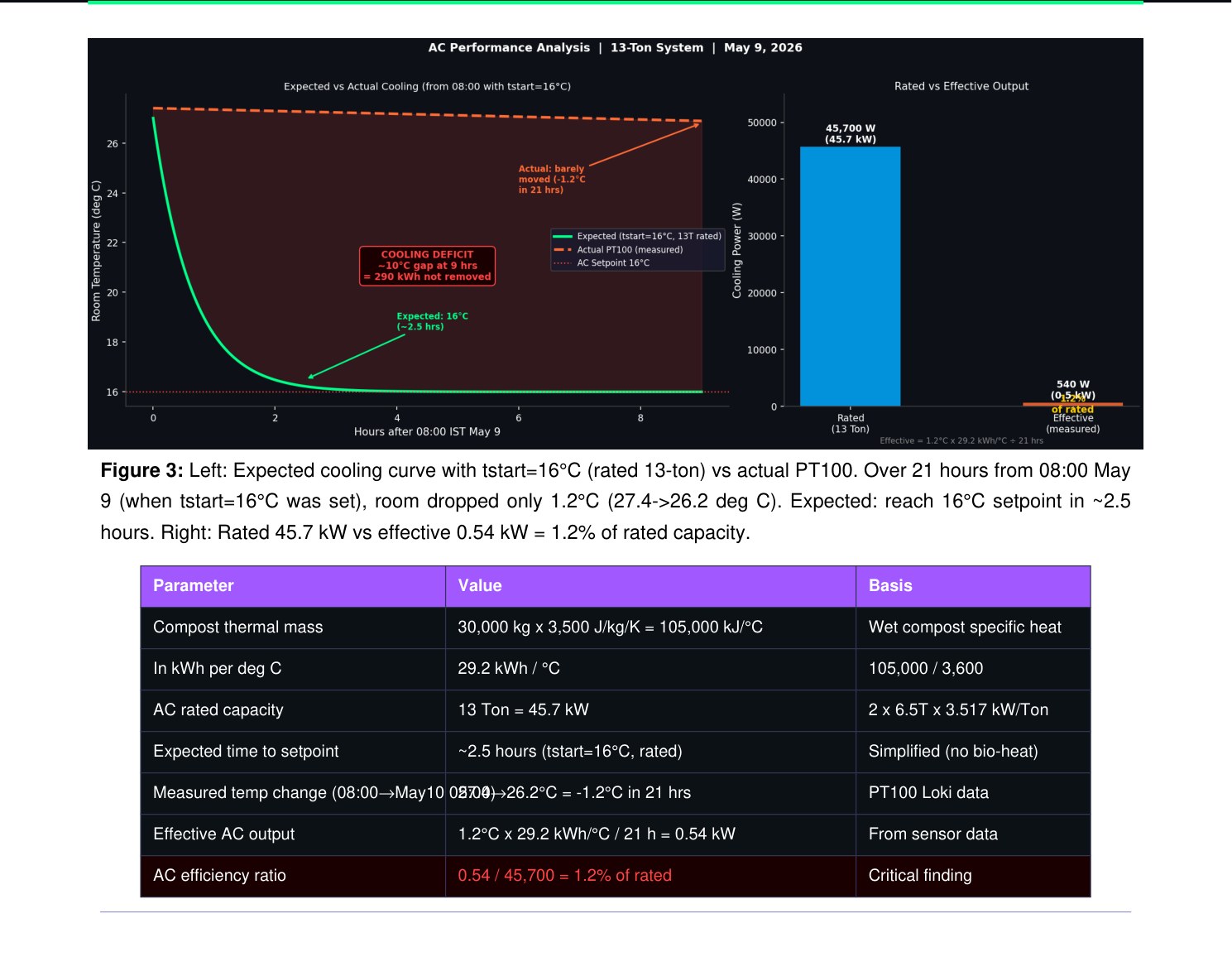
Figure 2 — Left: Expected cooling curve (green) vs actual room temperature (red). A functioning 13-ton AC should reach setpoint in ~2.5 hours. Actual room dropped only 1.2°C in 21 hours. Right: Bar chart comparing rated output (45.7 kW) vs measured effective output (0.54 kW) — just 1.2% of rated capacity.
By the Numbers
| Parameter | Value |
|---|---|
| AC system rated capacity | 13 Ton = 45.7 kW |
| Room temperature change over 21 hours | 27.4°C → 26.2°C = only −1.2°C |
| Compost thermal mass | ~30,000 kg × 3,500 J/kg·K |
| Measured effective AC output | ~0.54 kW (calculated from sensor data) |
| AC efficiency during failure | 1.2% of rated capacity |
| Root cause confirmed | Complete R-404A refrigerant loss |
Why This Could Have Been Catastrophic
Spawn Run Day 8–9 is not a forgiving phase. The mycelium is generating 2–3 kW of biological heat continuously. Without active cooling to offset this, room temperature climbs steadily. Button mushroom mycelium above 28–30°C for extended periods can suffer irreversible damage — killing the entire batch.
In this case, the compost core temperature was already climbing (29.5°C → 32.3°C over 32 hours) when the system flagged the anomaly. Had the failure gone undetected for another 24–36 hours, temperatures would likely have crossed the critical threshold and the batch would have been lost entirely.
✅ Outcome
- AC technician called and on-site within hours of the analysis
- R-404A refrigerant leak confirmed and recharged
- Room temperature back to setpoint within 1 hour of recharge
- Spawn run batch completed successfully — no crop loss
- Preventive recommendation added: refrigerant pressure check at Day 5–6 of every spawn run
Bonus Finding: CO₂ Drop Mystery — Also Solved
A few days earlier (May 5–7), the same room showed a different anomaly: CO₂ would rise steadily through the day to 11,000–13,500 ppm, then drop sharply every evening between 17:00–22:00 IST down to 5,600–7,000 ppm. This consistent pattern triggered a separate analysis.
The answer turned out to involve a smart interaction between the cooling system and harvest operations:
- Primary cause — Cooling relay activation: When room temperature crossed the setpoint (24–25°C) each evening, the AC unit drew fresh outside air through the top intake louvers. Outside air in May (Haryana) contains only ~400 ppm CO₂ — a fraction of the 11,000+ ppm inside the room. This diluted the CO₂ rapidly.
- Why only in the evening: Daytime outside temperature is 40–44°C — too hot to use for cooling. By 18:00–19:00, outdoor temperature falls to 28–32°C, making fresh-air cooling effective for the first time each day. Both conditions — temperature threshold crossed AND outdoor air cool enough — align only at that hour, which is why the CO₂ drop was so consistent.
- Secondary cause — Harvest with open doors: Workers picking mushrooms in the evening left room doors open. Gallery air (low CO₂) exchanged with room air through the open doorway — the CO₂ sensor near the door detected fresh air entering immediately.
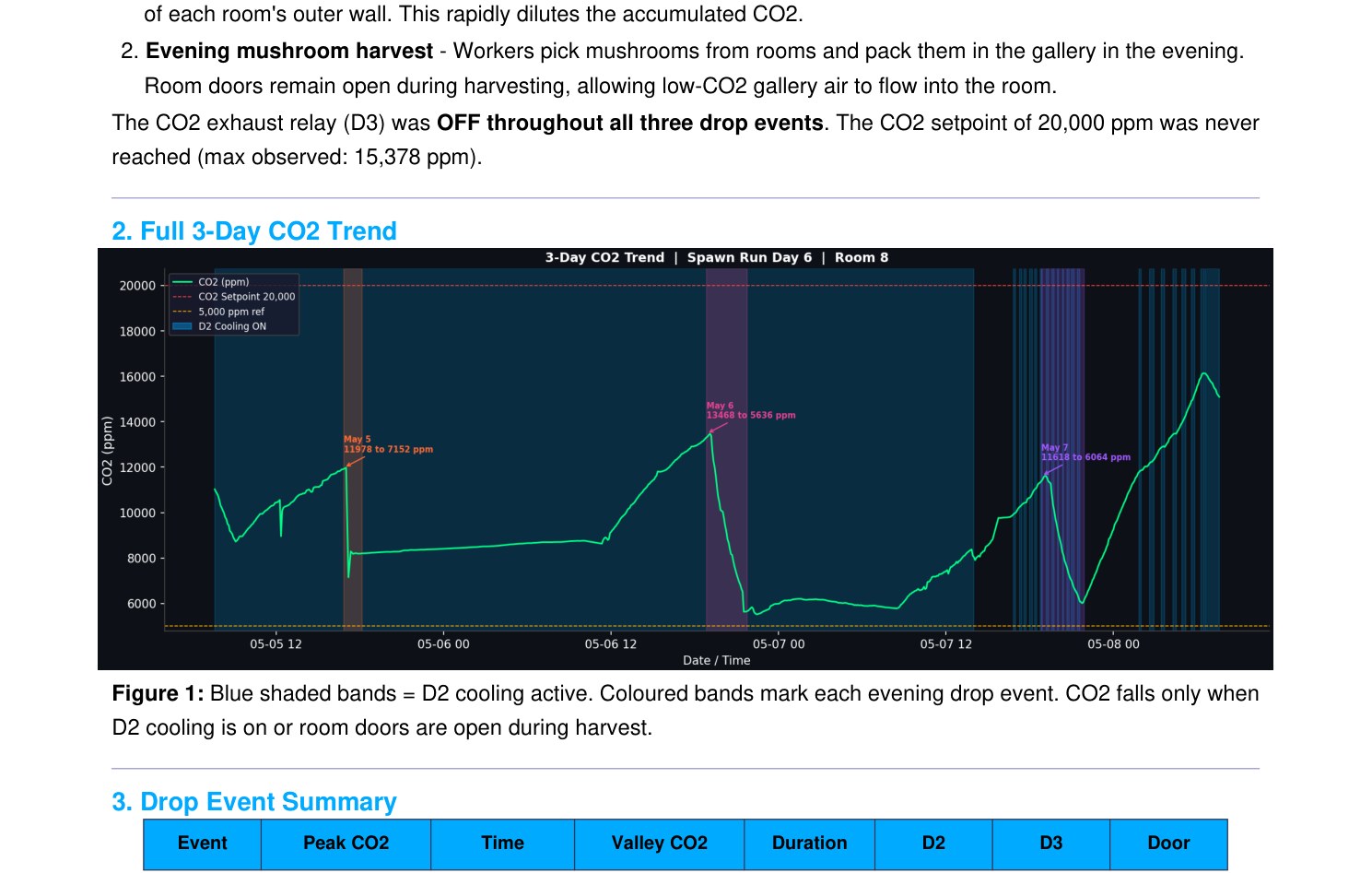
Figure — 3-day CO₂ trend (May 5–7). CO₂ rises each morning, peaks at 11,000–13,500 ppm, then drops sharply every evening between 17:00–22:00. Blue shaded bands = AC cooling relay active. The timing is perfectly consistent across all three days.
Key Insight
The CO₂ drop was not a malfunction. CO₂ remained within acceptable spawn run range (5,000–20,000 ppm) throughout. However, the analysis helped optimise the CO₂ setpoint and harvest sequencing to prevent borderline dips during future batches.
On the Ground — AC Technician at Work
Below is the actual service work from the day following our analysis. The AC technician confirmed R-404A refrigerant had completely leaked, and recharged both compressor units on-site.
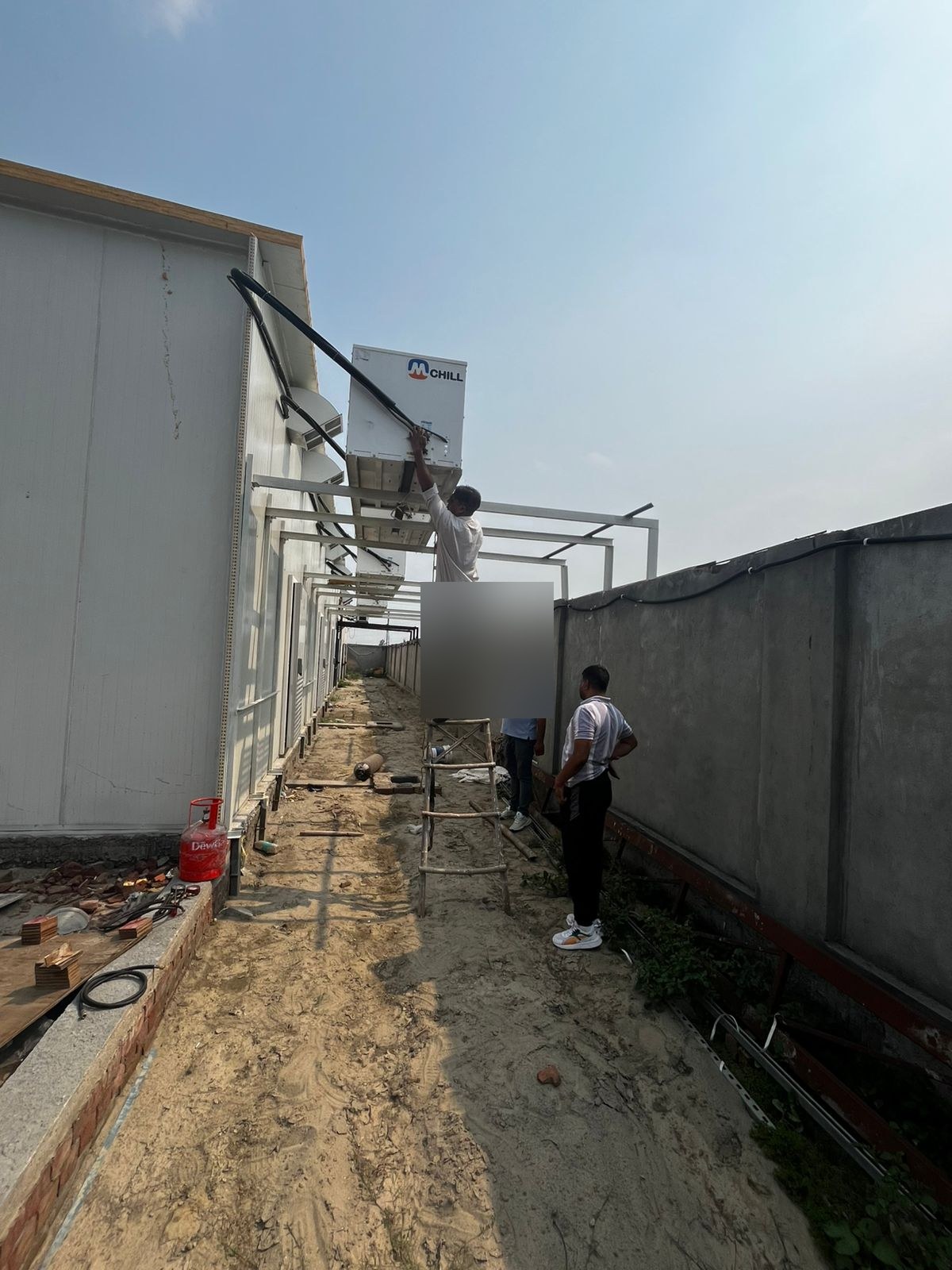
The AC technician refilling R-404A refrigerant into the grow room cooling unit — the day after our sensor analysis flagged the failure. The red cylinder is the refrigerant supply. Compressor units are mounted on the outer wall of the PUF-insulated grow rooms.
What Made Early Detection Possible
Traditional grow room management relies on periodic manual checks — a farmer or operator walking into the room and reading a thermometer. By the time a problem is noticed this way, hours or days may have passed.
The Contol-X system logs every sensor reading continuously. This means:
- Every relay state is recorded — we could confirm D2 (AC compressor relay) was energised for all 32 hours. It was not a control failure.
- Every setpoint change is time-stamped — we could see the operator aggressively lowering the setpoint and confirm the room had zero response.
- Room temperature vs setpoint gap is visible immediately — the divergence between what was commanded and what was measured made the failure unmistakable.
- The data ruled out other causes — CO₂ fan operation, humidifier relay, door events, and compost heat were all accounted for, leaving the AC as the only possible explanation.
Lessons for Mushroom Farmers
This case demonstrates several important points for anyone running a commercial mushroom grow room:
- An AC relay being ON does not mean the AC is working. A compressor can run with zero refrigerant, drawing power and producing no cooling. Without temperature data, you will not know.
- Spawn Run Day 8–9 is the highest-risk period for heat damage. This is when biological heat peaks and when AC failure is most dangerous. Monitoring must be most vigilant at this stage.
- Refrigerant leaks are silent and gradual. A small leak that started weeks earlier may go completely unnoticed until the system has lost enough charge to fail. Scheduled pressure checks (every spawn run) are essential preventive maintenance.
- Reaction time is everything. Getting an AC technician on-site the same day — vs. 2 days later — can be the difference between a saved batch and a total loss.
Protect Your Grow Room With Real-Time Monitoring
Contol-X continuously monitors every parameter in your mushroom grow room — temperature, CO₂, humidity, relay states and setpoints — 24/7. Anomalies are visible the moment they begin, not after the damage is done.
📞 Call +91-7779996307